L’expérience de Milgram
🧪 Contexte : Milgram, Arendt et la banalité du mal
Dans les années 1960, Stanley Milgram, psychologue à Yale, s’inspire du procès Eichmann (organisateur de la "solution finale") et du livre d’Hannah Arendt, Eichmann à Jérusalem, pour interroger l’obéissance à l’autorité. Arendt y développe la notion de « banalité du mal » : Eichmann ne semble pas monstrueux, mais ordinaire. Le mal vient d’une incapacité à penser, à se mettre à la place d’autrui.
Context: Milgram, Arendt and the banality of evil
In the 1960s Stanley Milgram, a psychologist at Yale, drew on the Eichmann trial (Eichmann organised the "final solution") and on Hannah Arendt's book Eichmann in Jerusalem to investigate obedience to authority. In it Arendt develops the notion of the "banality of evil": Eichmann does not appear monstrous, but ordinary. Evil comes from an inability to think, to put oneself in someone else's place.

Eichman vs Arendt
🧫 L’expérience de Milgram : principe et déroulement
Milgram publie une annonce pour une fausse expérience sur la mémoire :
- Un « moniteur » (le vrai sujet de l’étude) pense aider à tester la mémoire d’un élève (un comparse, acteur).
- À chaque erreur de l'élève, le moniteur doit lui envoyer une décharge électrique croissante.
- Les cris de douleur (fictifs) augmentent, mais le scientifique présent insiste pour continuer.
- Dans plusieurs variantes, la victime prétend avoir un problème cardiaque.
The Milgram experiment: principle and course
Milgram places an advertisement for a fake experiment on memory:
- A "teacher" (the real subject of the study) believes they are helping to test the memory of a learner (a confederate, an actor).
- At each mistake by the learner, the teacher must administer an increasing electric shock.
- The (fictitious) cries of pain grow louder, but the scientist present insists on continuing.
- In several variants, the victim claims to have a heart condition.
📉 Résultats choquants
La majorité des participants va jusqu’au bout, infligeant des décharges maximales, malgré :
- les cris,
- les supplications,
- l’absence de contrainte physique ou menace réelle.
Shocking results
The majority of participants go all the way, inflicting maximum shocks, despite:
- the cries,
- the pleading,
- the absence of any physical constraint or real threat.
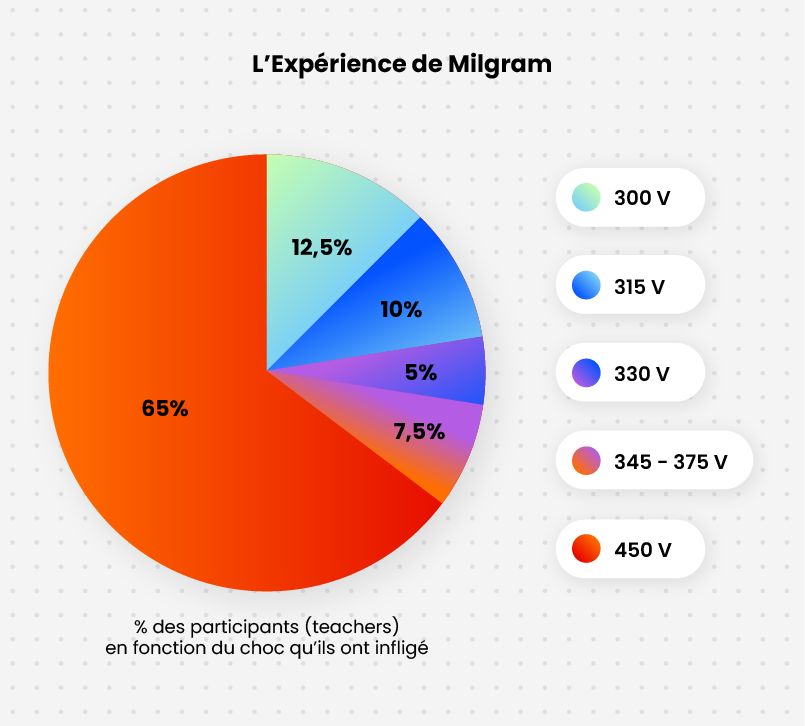
👉 L’obéissance est massive, sans totalitarisme, sans propagande, sans peur physique.
👉 Obedience is massive, without totalitarianism, without propaganda, without physical fear.
🧠 Analyse : pourquoi cette soumission ?
-
Autorité de la science La figure du savant est hautement respectée, perçue comme légitime et compétente, même sans vérification possible de ses affirmations.
-
Prestige universitaire Dans un contexte démocratique pacifique (États-Unis, 1960s), la science remplace le parti, l’armée ou l’Église comme source d’autorité morale.
-
Absence de distance critique Le sujet ne réfléchit pas, ne questionne pas le cadre, et oublie les droits de l’homme, qu’on lui a pourtant enseignés comme valeur suprême.
Analysis: why this submission?
-
The authority of science The figure of the scholar is highly respected, perceived as legitimate and competent, even where no verification of their claims is possible.
-
Academic prestige In a peaceful democratic context (United States, 1960s), science replaces the party, the army or the Church as a source of moral authority.
-
Absence of critical distance The subject does not think, does not question the framework, and forgets the human rights they were nonetheless taught to regard as the supreme value.
⚠️ Impact sur la pensée critique
- L’expérience révèle une fragilité de la pensée critique, même en démocratie.
- L’autorité scientifique peut susciter une obéissance aveugle, similaire à celle d’un régime autoritaire.
- Pourtant, rien ne contraignait physiquement les sujets à obéir.
Impact on critical thinking
- The experiment reveals a fragility of critical thinking, even in a democracy.
- Scientific authority can elicit a blind obedience similar to that found under an authoritarian regime.
- And yet nothing physically forced the subjects to obey.
🧭 Conclusion : un avertissement éthique
- Obéir à l’autorité sans réflexion peut mener à des actes graves, même envers des inconnus.
- La pensée critique, la capacité de dire non et de se mettre à la place de l’autre, est essentielle pour prévenir la banalité du mal.
- L'expérience de Milgram nous interpelle sur la responsabilité morale individuelle face à toute forme d'autorité, même scientifique.
Conclusion: an ethical warning
- Obeying authority without reflection can lead to grave acts, even towards strangers.
- Critical thinking, the capacity to say no and to put oneself in the other person's place, is essential in order to prevent the banality of evil.
- The Milgram experiment confronts us with individual moral responsibility in the face of every form of authority, including the scientific kind.