The fundamental Attitude of Critical Thinking
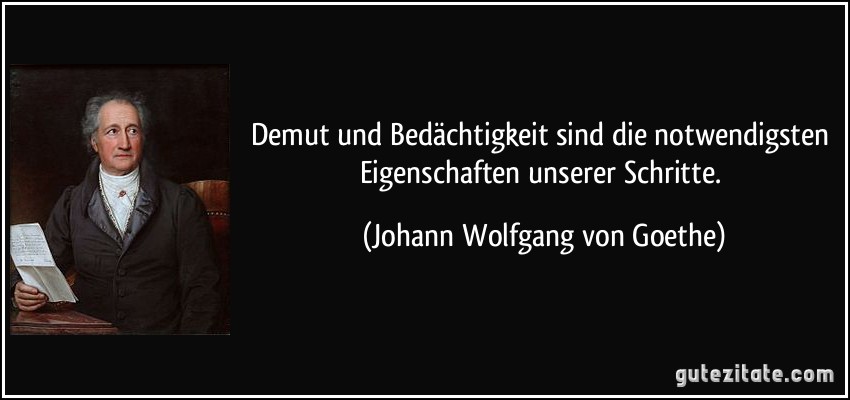
Humility and deliberation are the most necessary qualities of our steps. (Goethe)
Critical thinking begins with a particular mindset, which includes the following elements:
1. Intellectual curiosity
- An active interest in various topics and perspectives
- A willingness to ask questions and to seek answers
- A desire to go beyond superficial knowledge
2. Intellectual humility 1
- Recognizing the limits of one's own knowledge
- A willingness to examine and revise one's own convictions
- Openness to criticism and feedback
2 bis. Or prudence
As an alternative to humility, the basic attitude of critical thinking can also be summed up as prudence.
In Greek philosophy (e.g. in Aristotle), sophrosyne (prudence, temperance, Greek σωφροσύνη) was regarded as a virtue related to humility — a balance between overestimating oneself and submissiveness.
Examples:
- An athlete who does not boast after a victory, but also does not deny their achievement.
- A manager who acts neither risk-averse nor recklessly, but decides in a measured way.
- Someone who stays calm in an argument and neither becomes abusive nor submits.
3. Intellectual autonomy
- Independent thinking and judgment
- Resistance to the uncritical adoption of opinions
- Responsibility for one's own convictions and decisions
4. Intellectual integrity
- Consistent application of intellectual standards
- Honesty about contradictions in one's own thinking
- A willingness to acknowledge uncomfortable truths
5. Intellectual perseverance
- Persistence in solving complex problems
- Patience in dealing with ambiguity and uncertainty
- A willingness to invest time and effort in thorough thinking
In the beginning is the deed — the courage to act
For all our restraint, level-headedness and moral integrity, we should not lose sight of what this is ultimately about: the good life.
Life is out there on the street, in the field, in the forest or on the water, and only rarely at the desk or in front of a phone.
For the attitudes named so far have a downside. Whoever takes the limits of their own knowledge seriously may unlearn how to judge. The readiness to examine every conviction then hardens into a permanent state of examining; openness to counter-arguments becomes a comfortable refusal to commit. Those who never take a stand can never be wrong, but they have gained nothing by it: they have merely postponed the question.
Examining is a means, not an end. At some point the weighing is over and a decision has to be made: change careers or stay, object or keep silent, take this medicine or that one. A judgement that never issues in an action remains without consequence.
Complete certainty is rare. Acting under uncertainty is not the exception but the rule, and refusing to decide is itself a decision: usually in favour of things as they are.
Courage here means two things. First, exposing one's own judgement to reality: only in acting does it emerge whether we have thought correctly, and the world corrects us more thoroughly than any further reflection at the desk. Second, voicing a judgement even when doing so becomes uncomfortable.
In concrete terms this means:
- deciding even though not every question has been settled
- holding a well-founded opinion, even against the majority
- admitting a mistake and changing the course taken

Between pride and humility stands a third thing, to which life belongs, and that is courage. (Fontane)
Courage is therefore not the opposite of humility but its counterweight. Only together do they make up an attitude that dares both to think and to act. In the beginning, then, is not the word but the deed.2