What is Critical Thinking?
Critical thinking is essential to make sense of our world, especially with advertisers and politicians all telling us loudly that they know best. We need to be able to look at the evidence and work out whether we agree with them. (Helen Czerski)
What do we mean when we talk about critical thinking?
Critical thinking is the answer to the question:
Why should I believe this?
Critical thinking is, on the one hand, the ability to think reflectively and independently, as well as to formulate thoughts clearly and rationally. It is an active and systematic process that aims to analyze, evaluate, and interpret information.
The goal: to make well-informed decisions for ourselves, our fellow humans, and our environment.1
At its core, critical thinking means thinking for yourself. It is about:
- analyzing ideas and arguments
- evaluating arguments and claims
- questioning assertions
- drawing conclusions and finding alternatives
- keeping an open mind (without lapsing into naivety)
- doubting constructively
- thinking for yourself, in order to form your own opinions and make your own decisions
The origin (etymology) of critical thinking
From Kant's Critique of Pure Reason, through a critical point, to the critical times we live in, "critical" is everywhere and has many faces.
It comes to us in part through the French "critique", which gives us "critical" and "criticism".
Originally from the Latin "criticus". The Romans took it, as so often, from the Greeks, where it is "κριτικός" (kritikos) and means "able to discern" or "able to judge". It is related to κρίσις (crisis) and derived from the verb "krinein", which means something like "to distinguish", "to select", "to decide", "to sift".
Another important thinker in the history of critical thinking was John Dewey (1910), a pragmatist American philosopher who called it "reflective thinking". For Dewey, reflective or critical thinking is the: "active, persistent and careful consideration of any belief or supposed form of knowledge in the light of the grounds that support it, and the further conclusions to which it tends."2
Critical thinking as metacognition
Metacognition? Meta- what now? It sounds very fancy and academic, but it is quite simply thinking about thinking. Philosophers call this "taking the meta-level", and since we are talking about cognition, it is meta-cognition.
We should simply ask ourselves more often when we are thinking well and when we are going astray — and why.
One of the wisest of the ancient philosophers, Socrates — yet another ancient Greek, and the hero of our story — showed how it's done with his dialogues, which his student Plato wrote down.
"I know that I know nothing"
literally: "For I myself knew that I knew nothing at all ..."
Socrates in Plato: Apology of Socrates 22d
Socrates, of course, did not mean to say that he is a fool, but simply that he is aware that his knowledge is limited. Socrates questioned himself and others again and again, in order to understand what they really know and what is merely opinion or prejudice.
His constant questioning of his fellow citizens' convictions earned him deep friendships, but also made him many enemies, who in the end sentenced him to death.
Skills and attitudes of critical thinking
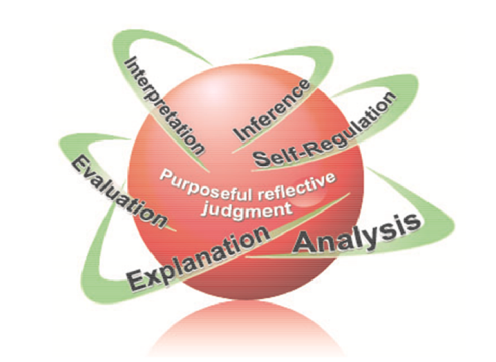
In modern times, critical thinking was brought back to prominence in part by Peter Facione. In his well-known "Delphi Report"3, following the many experts involved, he distinguished above all two things:
cognitive skills vs. affective dispositions
The cognitive skills include:
- Interpretation: the ability to understand information, statements or data and to grasp their meaning in the given context.
- Analysis: the ability to break arguments, claims or problems down into their components and to recognise their structure and their connections.
- Evaluation: the ability to examine and judge critically the credibility of statements, arguments or sources.
- Inference: the ability to draw logical conclusions from the available information and to derive hypotheses.
- Explanation: the ability to present and justify one's own reasoning, arguments and conclusions clearly and comprehensibly.
- Self-regulation: the ability to monitor one's own thinking, to spot errors and to correct the thought process where necessary.
Attitudes (the affective side)
In addition to the cognitive skills, Facione emphasizes the affective attitudes (affective dispositions) as the second important side of critical thinking. These include attitudes such as:
- intellectual curiosity,
- open-mindedness,
- fairness,
- intellectual humility,
- the courage to face the truth,
- perseverance,
- the willingness to question one's own biases4
I have highlighted the points that are rarely mentioned but are the most important.
Who doesn't know very intelligent people, with all the cognitive skills (scientists, philosophers, business leaders), who nevertheless fail because they are unable to question their own truths?
These attitudes foster a constructive, self-critical, and open way of thinking.
These attitudes help you:
- Orientation: they help you not to wander off blindly.
- Collaboration: they help you work together with people who hold different views.
- Self-correction: they help you to say, "Oops, I got that wrong."
- Change: they help you to keep developing.
Critical thinking is not an innate ability; it must be learned and continuously developed.
It requires practice, self-reflection, and the willingness to question your own thought processes.
Let's get started!